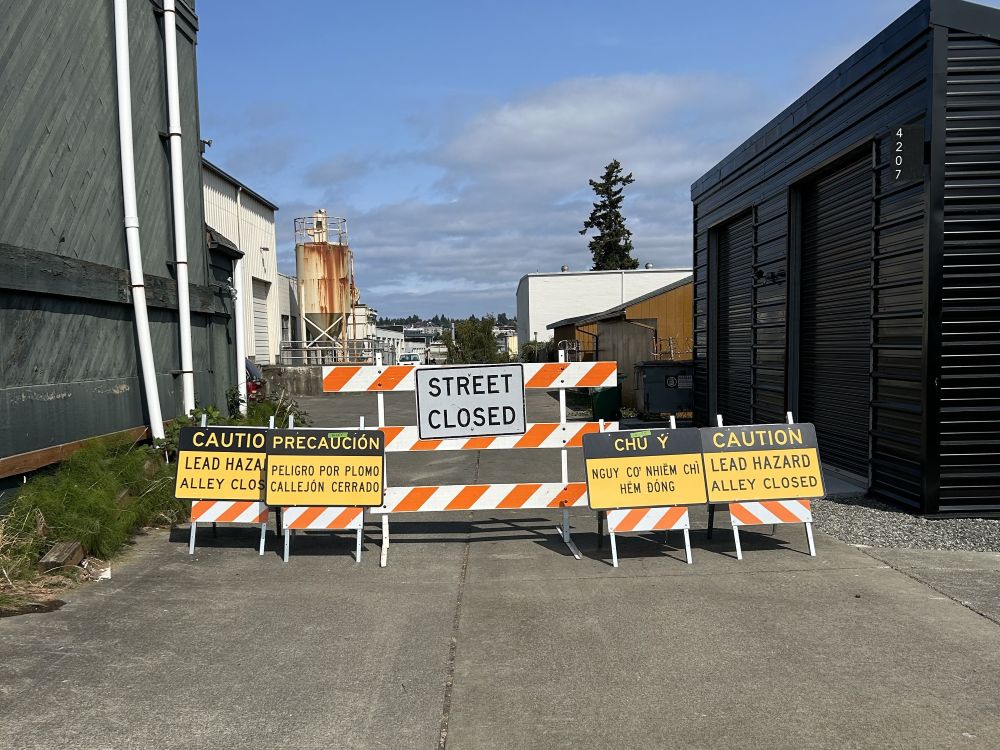
Seattle Public Utilities is working with City, County, State, and Federal partners to address lead contamination found on the 4200 block of 23rd Ave W, as part of our work to ensure compliance with discharges related to our drainage and wastewater system.
The area is blocked off to pedestrian and vehicle traffic with clearly marked signage, and we are cleaning the known areas of concern.
Pedestrians should avoid the east side of 23rd Ave W between W Commodore Way and W Elmore Street and the alley between 22nd Avenue W and 23rd Avenue W for the near future.
How we are addressing the lead contamination
- Closing the area: SPU and the Seattle Department of Transportation implemented street and sidewalk closures based on Public Health – Seattle & King County (Public Health) guidance. The closures apply to the affected block between W Commodore Way and W Elmore Street and the alley between 22nd Avenue W and 23rd Avenue W. This area has been clearly marked with signage to prevent vehicle and pedestrian traffic.
- Cleaning the known areas of concern: SPU hired a specialized contractor to start cleaning the known areas of concern on Aug. 27. SPU is now implementing a comprehensive clean-up plan. We are conducting testing and analysis to determine any additional clean-up needs.
- Preventing further lead impacts: At this time SPU and other agencies are directing investigative and enforcement efforts at the Dyno Battery facility located in the area. SPU and regulatory partners are working with Dyno Battery to prevent further lead impacts outside of the facility.
- Collecting and testing samples: SPU collected samples to understand the extent of the contamination and the potential health risk to residents and to people who work in or visit the area. Currently, testing confirms that we have blocked off and begun cleaning the known areas of concern.
- Taking enforcement action: SPU will issue an order to Dyno Battery to control the source of the contamination and support remediation efforts for discharges related to our drainage and wastewater system. We are also coordinating with other enforcement agencies on their actions, including the Washington State Department of Ecology.
Frequently Asked Questions
What is the source of the contamination?
At this time SPU and other agencies are directing investigative and enforcement efforts at the Dyno Battery facility located in the area.
How did agencies become aware of this issue?
The Washington State Department of Labor & Industries (L&I) conducted an inspection related to workplace conditions at Dyno Battery involving lead exposure. L&I and the Washington State Department of Health alerted Public Health about the potential for workers to track lead home and expose their families, especially young children. As they learned more, Public Health became concerned about possible environmental contamination and contacted SPU and other regulatory agencies to begin investigating the potential for lead contamination in and around Dyno Battery.
After SPU was notified, we began testing areas beyond the business and its property. After finding elevated lead levels in nearby stormwater catch basins and the street, we blocked off the area and hired a specialized contractor to begin cleaning.
Should I avoid the area?
Yes. While the area is blocked off to pedestrian and vehicle traffic with clearly marked signage and we are cleaning the known areas of concern, you should avoid the area for the near future.
This area includes the east side of 23rd Ave W between W Commodore Way and W Elmore Street and the alley between 22nd Avenue W and 23rd Avenue W.
If you pass through the area regularly, be sure to damp dust, damp mop and vacuum your space with a HEPA vacuum. Remove shoes at the door, wipe wheelchair and stroller wheels with a damp cloth, and wash your hands to avoid tracking lead into your home, particularly if you have children or pets that play on the floor.
The greatest risk is tracking it home and then exposing young children and pets. For more information on potential exposure and health effects, visit the Public Health Insider Blog.
What did initial testing show?
SPU collected samples from the roadway, and a stormwater catch basin along 23rd Avenue W in late July, followed by confirmatory testing in August. Results showed levels about the hazardous waste threshold. These known hotspots are being cleaned by a specialized contractor.
Based on this data, SPU conducted a follow-up screening to help inform the extent of contamination. This screening indicated that the known areas of concern have been blocked off. SPU collected additional samples from nearby locations to understand any additional impacts in the neighborhood. We are awaiting further results and analysis to determine what additional steps may be needed.
For information on testing by Public Health at a nearby private daycare, visit the Public Health Insider blog.
What are the plans to clean up the area?
SPU hired a specialized contractor to start cleaning the known areas of concern on Aug. 27.
SPU is now implementing a comprehensive clean-up plan. We are conducting testing and analysis to determine any additional clean-up needs. Currently, we do not have a timeline for reopening the area.
I own a business in the area. What steps can I take to protect my customers and employees?
Both the University of Washington and Washington State Department of Labor & Industries provide free lead testing and consultation resources for businesses. See the details: Business Lead Testing and Consultation Resources.
What agencies are involved in addressing the lead contamination?
- King County Industrial Waste Program in the Department of Natural Resources and Parks: Regulation of commercial and industrial customers that discharge wastewater into the regional wastewater system.
- Contact: erzucco@kingcounty.gov
- Public Health – Seattle & King County: Public health recommendations to protect people from environmental exposures and harmful substances – particularly protecting children.
- Contact: publichealth@kingcounty.gov
- Puget Sound Clean Air Agency: Regulation of businesses with equipment, processes, or activities that emit air pollution.
- Contact: PhyllisM@pscleanair.gov, 206-689-4077
- Seattle Department of Transportation: Manages public right of way and travel on city streets and sidewalks in the area.
- Contact: SDOT.Media@seattle.gov, (206) 684-3151
- Seattle Public Utilities: Enforces compliance with discharges related to its drainage and wastewater system.
- Contact: SPU_Media@seattle.gov, 206-446-8267
- U.S. Environmental Protection Agency: Regulating waste handling, preventing accidental discharges, and leading emergency cleanups when hazardous substances are released.
- Washington State Department of Ecology: Hazardous Waste and Toxics Reduction program focuses on safe management and reduction of hazardous waste in Washington by enforcing Washington’s toxics laws, including the Dangerous Waste regulations.
- Contact: 206-594-0000
- Washington State Department of Health: Site Assessment Program works to prevent and reduce exposure to harmful chemicals in the air, soil, or water.
- Contact: DOH-PIO@doh.wa.gov
- Washington State Department of Labor & Industries: Protects the safety and health of the state’s workers and inspects workplaces for safety compliance.
- Contact: matt.ross@lni.wa.gov, (360) 706-4857