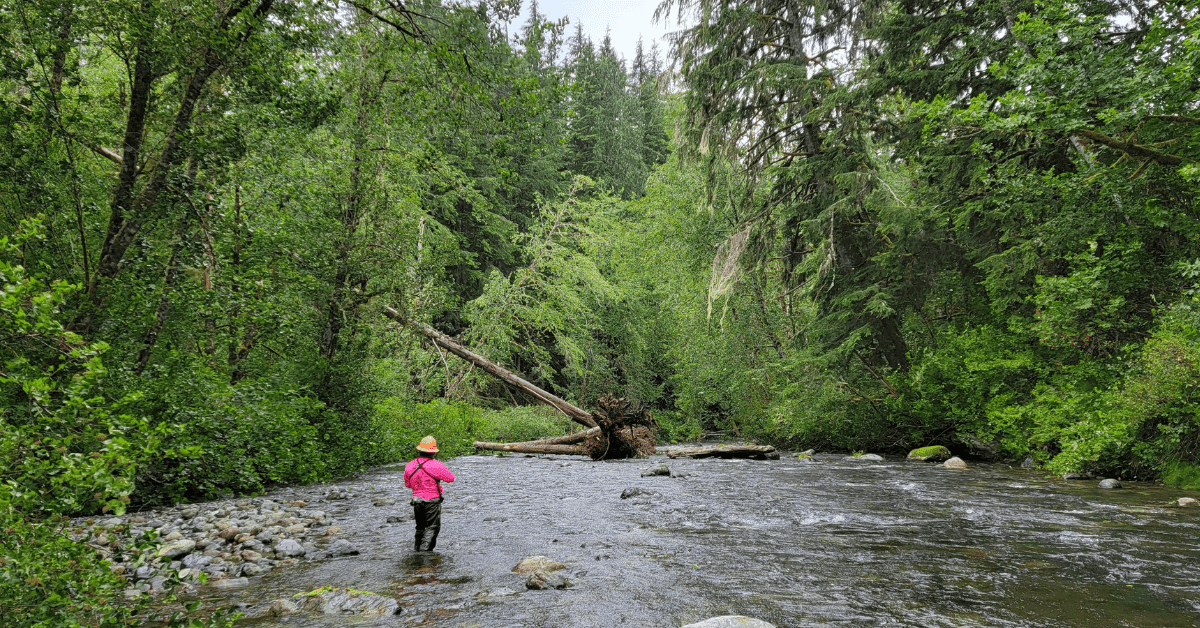
The Cascade foothills are home to the small but important South Fork Tolt Hydroelectric Project. We are currently in the process of renewing the project’s license with the Federal Energy Regulatory Commission (FERC). This process takes several years. A significant part of the work is to identify gaps in our current knowledge in order to design studies to help fill those gaps.
Today’s studies are building on previous learnings and will inform future decisions.
To see how today’s studies will help guide tomorrow’s decisions, we can look back at what has been done before.
Under the project’s current license, the City works closely with state and federal agencies and the Tulalip Tribes. This group is called the Tolt Fishery Advisory Committee (TFAC). Working together, TFAC oversees compliance with the current license and has designed studies over the years to better understand the needs of the river and its fish.
TFAC started their first study in the early 1990s. A field team created an inventory of habitat features, mapped pools and riffles, and counted fallen trees and other forms of large woody debris that create natural habitat in and near the river.
Knowing about the river’s characteristics is important because fish need a variety of habitat conditions to thrive throughout their life cycles. Committee members use what they learn from studies like these to inform decisions about habitat restoration. This kind of active learning and real-time decision-making is called “adaptive management.”
Peggy Miller is one of four FERC Coordinators for the Washington Department of Fish and Wildlife (WDFW). Peggy served as a member of the TFAC from 2010 to 2023. She explained that adaptive management is an iterative process: “You try one thing, see how it works, learn from what you tried, and then either do it again or try something else.”
She explained further, “The natural functions of the river are always changing. Under the current FERC license, TFAC has been able to implement projects that aim to mimic natural functions. We don’t always get it right the first time, so we rely on monitoring and follow-up studies so we can learn and adapt.”
Derek Marks, TFAC member since 2012, is the Timber, Fish, and Wildlife Manager for the Tulalip Tribes. Agreeing with Peggy, he sees TFAC’s adaptive management activities as helping “kick-start the habitat’s natural healing processes.”
Let’s look more closely at the woody debris in the South Fork Tolt to see what adaptive management looks like in practice.
After TFAC completed the initial study of habitat conditions in the river, they determined that the river needed more log jams, because log jams create habitat variations that are good for fish. Increasing the river’s natural woody debris would increase the complexity of river habitat, retain more gravel for spawning, and create access to side channels that give salmon and steelhead more places to rear.
To make that happen, the City worked with TFAC in 2005 to use a helicopter to place 192 massive pieces of wood into the river, many with root wads still attached. Biologists call these materials “large woody debris.” Some pieces weighed as much as 23,000 pounds!
Continuing to collaborate with the TFAC, the City has funded multiple studies since then to monitor how well the idea worked. The initial project was so successful that 298 more pieces of large woody debris were strategically placed into the river in 2020 and 2021.
Working together means everyone shares the successes and the lessons.
Collaborating with partners on TFAC has given City staff, Tribal representatives, and state and federal agencies opportunities to learn and get better together. Derek commented, “The TFAC works well for us because everyone there is invested in the outcome. We all have a little bit of ownership in the work. When it goes well, we share pride in our successes. When it doesn’t, we share the learning.”
WDFW’s current FERC Coordinator for the South Fork Tolt is Leslie King. With a background in fish and habitat biology, she has been on TFAC for the last two years. Leslie noted: “So much of what we do is a learning process. It often takes years or decades to see the full extent of how our human activities affect the natural world. Our goals with these studies are to learn from the past and observe current conditions so we can make mindful decisions for the future.”
What’s next?
The City will continue to work with Tribes, state and federal agencies, and other Licensing Participants (LPs) to complete a series of relicensing studies as outlined in FERC’s Study Plan Determination. There will be a second year of field work in 2026. The information learned in these studies will inform the City’s application for a new license, which we expect to file in July 2027.
You can learn more about this project and the relicensing process at Seattle City Light. A Public Documents Library can be found under “Project Documents and Resources.”
You can read more about the TFAC and see pictures of the large woody debris work.
The Tulalip Tribes produced a short video highlighting this project. You can hear more from Derek Marks and watch footage of the Chinook helicopter airlifting trees:
Stay Informed – Sign up for our Mailing List to sign up to receive regular updates on the South Fork Tolt relicensing process delivered to your inbox.